
Residence report (zairyu todoke) for Japanese in the U.S.
The report is how a consulate knows you are in its district. It holds your name, passport, address, phone, email and an emergency contact. The consulate uses it to check on people after an incident or a disaster nearby, and to send safety notices by email (ORRnet FAQ, Ministry of Foreign Affairs of Japan).
Other services lean on it too. Overseas voter registration requires it, and only people who filed online can later apply online for a passport or for some certificates.
Who has to file
Article 16 of the Passport Act covers any holder of a Japanese passport who sets up an address or a place of residence abroad and stays three months or more.
The ministry's own examples are a work transfer, study abroad and settling for good. A student on a one-year exchange is covered as much as a family that moved here twenty years ago.
One report can cover a whole household. The head of the household files it and lists everyone living at the same address, a spouse or child who is not Japanese included. A non-Japanese member can be listed but cannot be the head.
Shorter stays have a different service. For a trip of under three months the ministry asks you to register with Tabireg, which sends the same kind of safety email for the dates you are away.
New procedure guides, by email
We’ll email you when we publish a new procedure guide. No ads, and you can unsubscribe at any time.
When to file it
The rule says without delay once you settle. If you are moving from Japan, ORRnet accepts the report from 90 days before you arrive, so it can be done while you are still packing. If the move falls through, you withdraw the report on ORRnet.
A paper report works differently: you hand it in at the consulate once you have arrived and have an address. Online, an address or a phone number that is not settled yet does not stop you from filing.
What to have ready
- Your Japanese passport number, or the number of an expired one while a new passport is in process
- An email address, which becomes your login ID
- Your U.S. address and phone, if you already have them
- Your registered domicile in Japan (honseki), your occupation and the dates of your stay
- An emergency contact where you live and a contact in Japan
- The details of the family members who live with you
Filing it, step by step
On the ORRnet home page you choose the option for people starting a new stay abroad and fill in the form. You do not have to work out which consulate is yours: ORRnet picks it from the address you enter.
That saves real confusion in this country. California is split between two consulates by county, so a family in Bakersfield belongs to San Francisco and one in Palmdale to Los Angeles. The California page explains where the line runs.
The ORRnet pages are written in Japanese. If you would rather file on paper, you collect the form at the consulate counter and hand it in there. The ministry spells out what that choice costs you: a paper report rules out applying online for passports and certificates later.
Keeping it up to date
The report is not a one-off. The same rule that makes you file it obliges you to report changes and to tell the consulate when you leave its district.
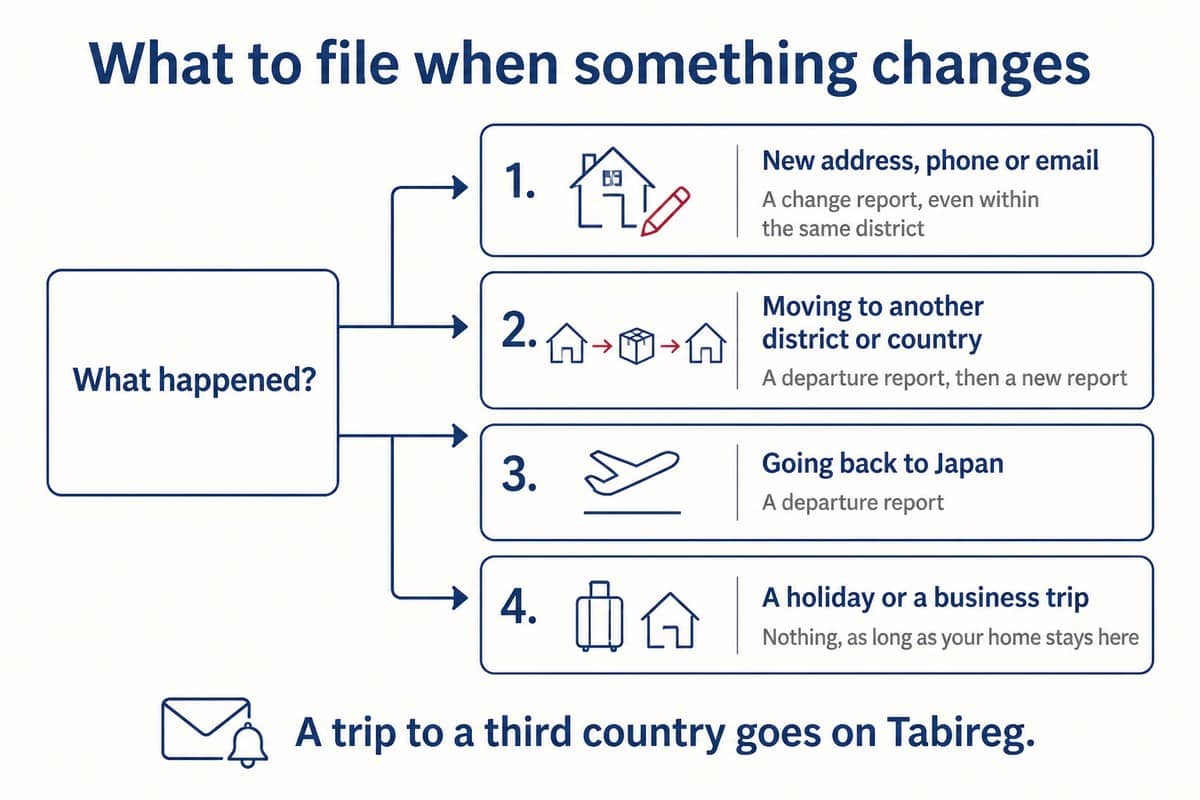
| What happened | What you file |
|---|---|
| You moved, even within the same consular district | A change report |
| New phone or email, or a new family member at home | A change report |
| You are moving to another country or to another consulate's district | A departure report first, then a new report for the new address |
| You are going back to Japan | A departure report, before you leave or after you arrive |
| A holiday or a business trip | Nothing, as long as your home stays here. A trip to a third country goes on Tabireg |
People on the overseas voter register have a second address to change, the one on the voter card. Our guide to voting from abroad covers that part.
If you never file it, or forget to close it
The ministry's FAQ describes the practical result rather than a penalty. Without a report the consulate does not know you are there, so after a disaster it cannot check on you or reach your family in Japan. And without a report there is no overseas voter registration.
Forgetting the departure report causes the opposite problem. The alerts keep arriving after you have left, and in an emergency the staff lose time trying to reach you instead of the people still in the district.
The ministry also closes reports itself. It treats you as gone once a year has passed since the end date on your report, or once the consulate has been unable to reach you for a year.The same happens when your passport expired more than a year ago, when your life is back in Japan, or when you no longer live at the address on the report.
Special cases
The online route it opens
An ORRnet report is the key to applying online for a Japanese passport and for some certificates. For a new passport, a change of details and some certificates, the ministry asks for the koseki electronic certificate identifier code, or else the original koseki tohon.
Applying online does not change how a passport is handed over. Collection is still in person, within the six-month window the passport guide describes.
Frequently asked questions
Is the residence report the same as the certificate of residence?
No. The report is a notice you give the consulate. The certificate of residence is a document the consulate issues to you for an institution in Japan, usually for an inheritance, a property or a pension.
Does it cost anything?
Neither the ORRnet pages nor its FAQ mention any fee for filing or updating the report.
How do I find out whether I already filed one?
The ministry's answer is short: file a new one, or ask the consulate that covers your address.
I forgot my ORRnet password
You reset it with your passport number and the email you registered. After too many wrong attempts the account locks, and you can try again two hours later.
My login email no longer works
Then you cannot log in, and only the consulate for your address can change the user ID. Have the new email address ready when you contact it.